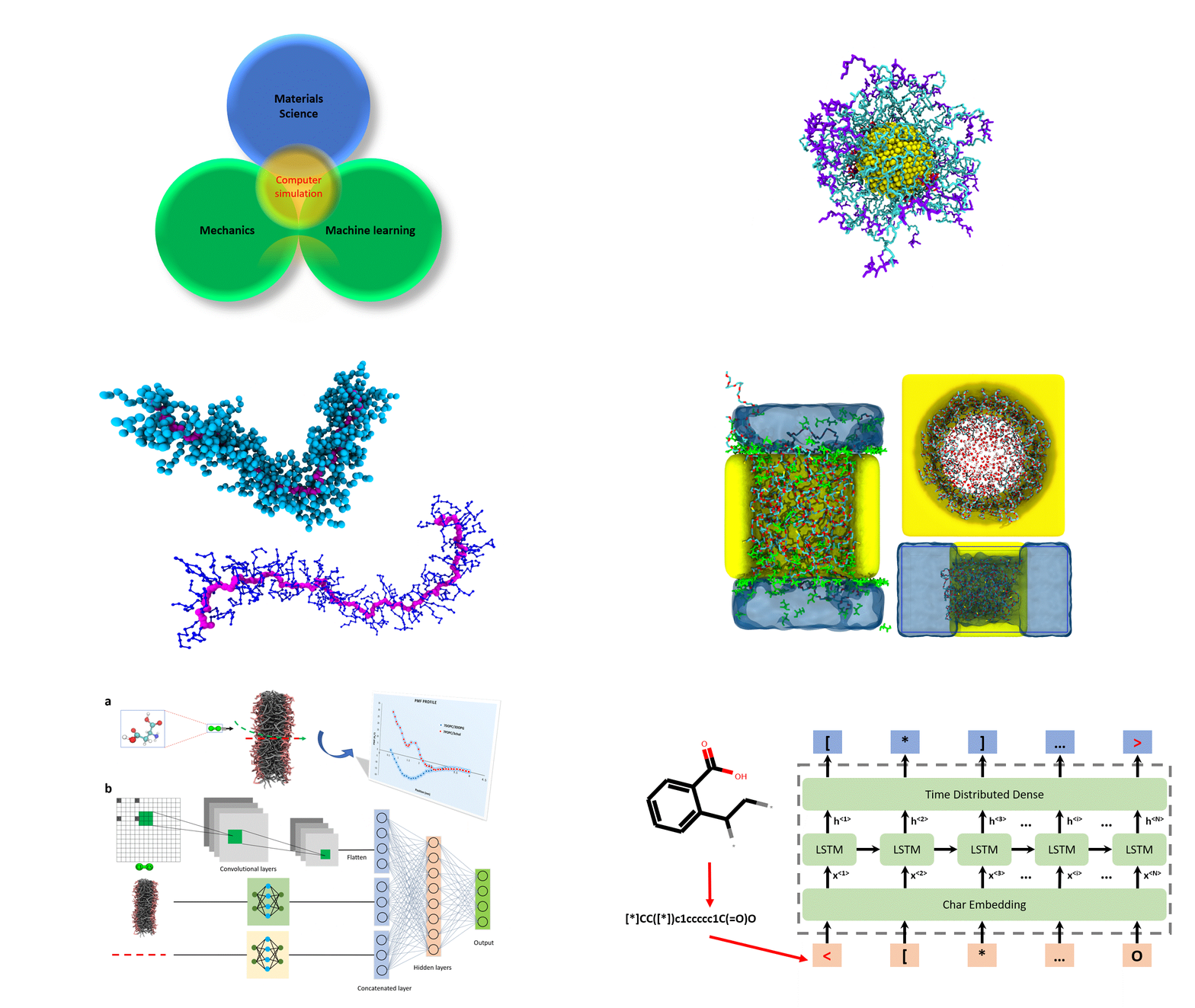
My research integrates soft matter physics, artificial intelligence, and high-performance computing to redefine the design and understanding of complex materials. By streamlining the discovery process, it is aimed to develop material-based solutions for critical societal challenges.
Currently, I am working on several soft matter problems by developing efficient computational scattering methods to resolve spatially-dependent dynamics across multiple spatiotemporal scales, focusing on bridging the gap between molecular simulation and experimental scattering. A special component of the effort is the development of a digital-twin platform for molecular scattering and coherent dynamics.
Key contribution:
- Refining experimental interpretation: elucidated the physico-chemical origins of the critical and noncritical background contributions in X-ray scattering for liquid-liquid critical phenomenon, improving data accuracy and interpretability.
- Supercritical fluid modeling: resolved a long-standing debate in molecular simulations for near-critical or supercritical fluids by incorporating long-range dispersion, enabling high-fidelity modeling and the extraction of density fluctuation/correlation length that follow universal scalings.
- Nonequilibrium dynamics: elucidated the fundamental differences in structure and dynamics between continuous and discontinuous shear thickening in colloidal suspensions (in terms of local packing and fluid-like vs. solid-like behavior), supported by experimental observations.
- Software development: engineered several computational and AI-driven suites for autonomous nanomaterials characterization, understanding, and design. These tools integrate machine learning with molecular modeling to automate the discovery of novel nanostructures.